
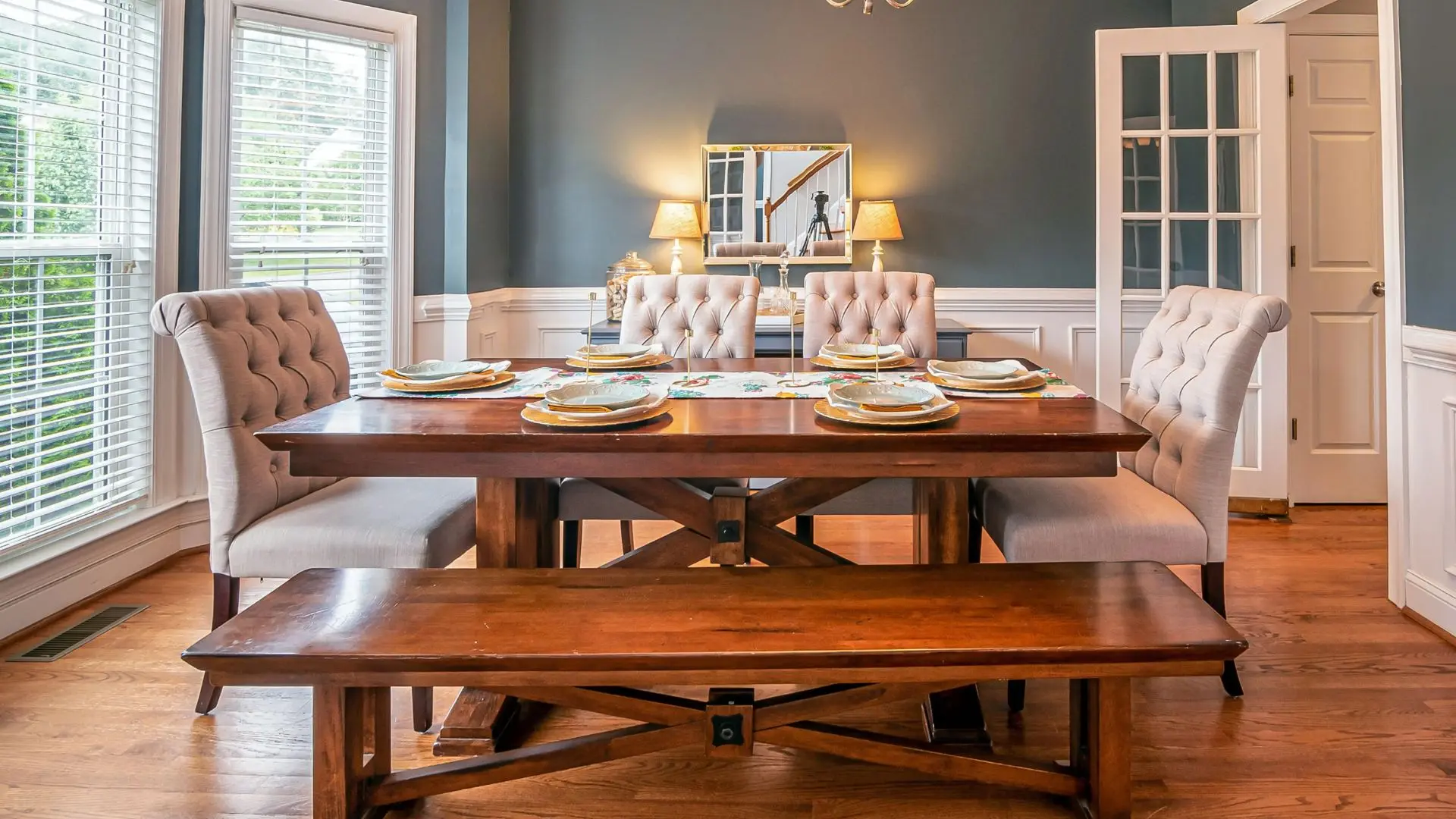
The short answer
- Dining table, 28 to 30 inches: choose a seat height of about 18 to 20 inches.
- Counter table, 34 to 36 inches: a stool with a 24 to 27 inch seat.
- Bar table, 40 to 42 inches: a stool with a 28 to 32 inch seat.
- Armchairs: the top of the arm must sit lower than the underside of the table, or the chair stays at the edge.
The 10 to 12 inch rule
Designers and furniture makers use the same number: leave about 10 to 12 inches between the top of the chair seat and the table. Most dining tables are 28 to 31 inches high and most dining seats are 17 to 20 inches[1], which is why standard pieces usually work together.
The formula: table height minus 10 to 12 inches = your seat height. A 30-inch table calls for a seat between 18 and 20 inches[2]. It works in reverse too: if you are keeping your chairs, add 10 to 12 inches to the seat height to find the right table.
Below 10 inches, knees and thighs press against the table. Above 12, the table feels high and you reach up to eat[2].
Measure the underside, not just the top
Your legs live under the table, so the number that really matters is the space between the seat and the underside of the table, not the tabletop[3]. The tabletop and the apron (the wooden band under the top on many tables) eat into that space. A table without an apron, like a pedestal or a slab on simple legs, gives you the most room.
- Measure from the floor to the top of the table.
- Measure from the floor to the lowest edge under it: the apron, a rail or the tabletop itself.
- Measure the chair's seat height, and its arm height if it has arms.
Armchairs: the measurement people miss
An armchair only slides under the table if the top of its arms clears the underside. Designers like at least 1.5 to 2 inches of space there, so fingers do not get pinched[4]. If the arms are higher, the chair still works for eating, but it stays parked at the table edge and needs more floor space behind it.
That is exactly the case with the barrel chair below. Its curved back doubles as the arm, and it reaches 29.5 inches, so it cannot tuck under any standard dining table.
The test: three chairs, five dining tables
Seat 19.5", arms 29.5", 29.5" tall
Seat 19.5", no arms, 30.5" tall
Seat 19.29", arms about 30", 30.31" tall
All three seats sit at about 19.5 inches, so the seat-to-table gap barely changes between them. What changes is what happens when you push them in. Here are five pairings with our dining tables, drawn to scale. Where a listing does not show the tabletop thickness (the 63" and 70" tables), we drew it at 1 inch.
All five tables at a glance
| Table | Height | Underside | Gap to seat | Verdict |
|---|---|---|---|---|
| 39" round pedestal, no apron | 29.5" | 28.8" | 10.0" | Comfortable |
| 47" round four legs, no apron | 30" | 28.9" | 10.5" | Comfortable |
| 63" rectangle frame under the top | 29.5" | measure it | 10.0" | Comfortable |
| 70" oval rail under the top | 29" | measure it | 9.5" | A little tight |
| 79" rectangle rail under the top | 30" | 29.0" | 10.5" | Comfortable |
Gap = table height minus the 19.5-inch seat. Underside = table height minus the tabletop thickness shown on the listing. Upholstered seats sink a little when you sit, which adds about half an inch of room.
What the test shows:
- Four of five tables land in the comfort zone with either chair: 10 to 10.5 inches.
- The 70-inch oval is the exception at 29 inches tall: 9.5 inches is a little tight. Fine for most people, but if your family is tall, choose a chair with an 18 to 19 inch seat for that table.
- Armchairs with high arms never tuck under. The barrel (29.5") and farmhouse (about 30") arms are higher than every underside. Plan 36 inches behind each one.
- The armless chair tucks under every table. That is why it works at the ends of a long table, where people walk past.
Simulate your own table and chair
Pick one of our pieces, or type your own measurements in inches.
Counter and bar height: four stools, two heights
The 10 to 12 inch gap applies to every table height[5]. A 36-inch counter wants a seat around 24 inches, and a 42-inch bar something closer to 30 inches[5]. We ran the same test with three stools at a standard 36" kitchen counter and a 42" bar, both with a 12" overhang.
Seat 24", barrel back
Seat 26", arms 34", footrest 8"
Seat 29", arms 37.5"
Rule of thumb: 24 to 26" stools for a 36" counter, 29 to 30" stools for a 42" bar. A 2" difference in the seat changes everything at this height, so check the seat height in the listing, not the name of the product.